


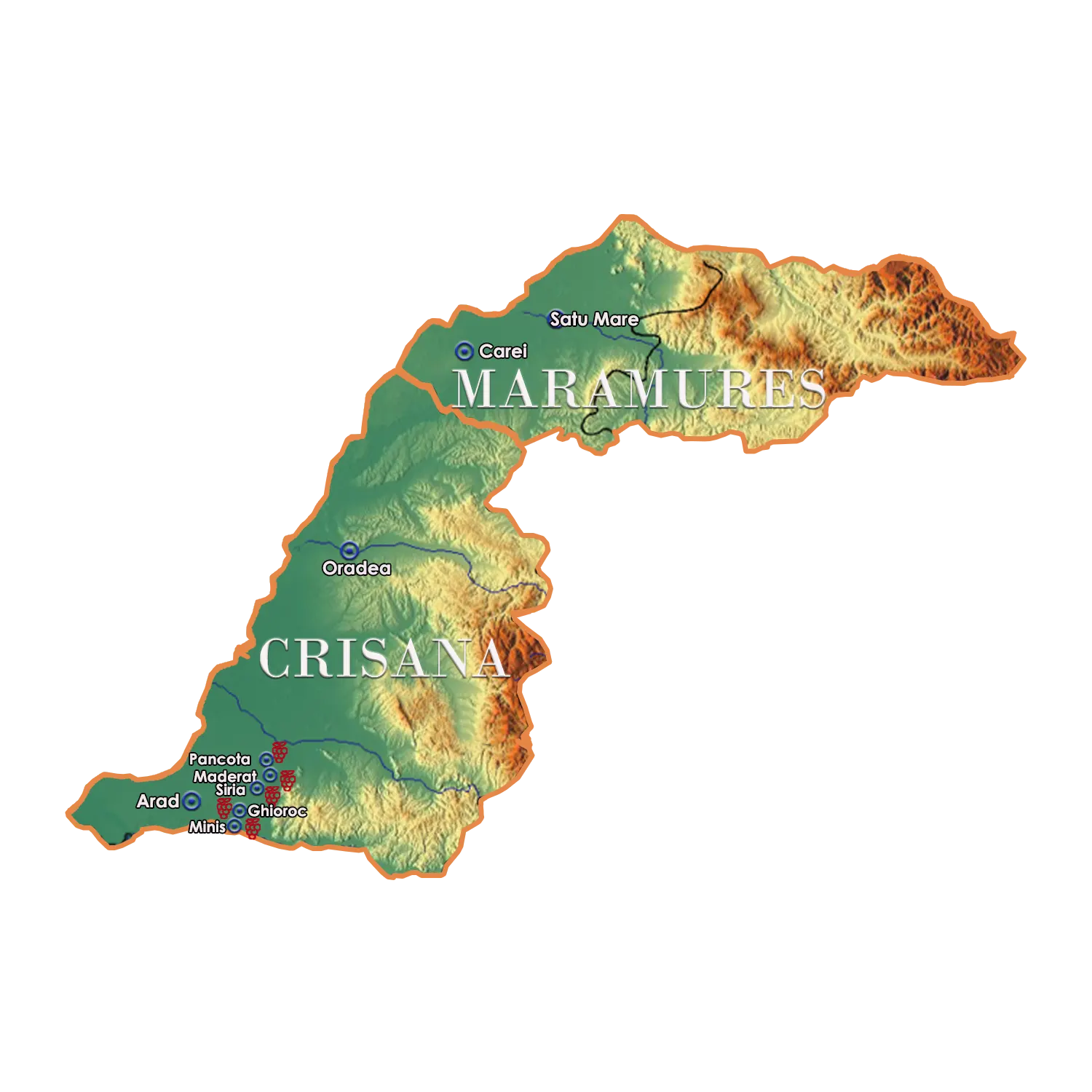
The history of viticulture in Minis-Maderat reaches far into the past. Wine-growing traditions in the area can be traced back to the 11th century, while documentary evidence appears several centuries later, during the period associated with Iancu de Hunedoara. By the late Middle Ages, wine had become an important element of the local economy, providing income for noble estates and surrounding communities.
Through periods of Ottoman and later Austrian influence, viticulture remained an important part of the identity of the region. One remarkable witness to this heritage is the historic wine cellar at Mocrea, constructed in 1606 with a capacity of approximately 800,000 litres and still in use today. The establishment of the Minis Winemaking School in 1880 and the Minis Winery Research and Production Station in 1957 further strengthened the vineyard's role as an important centre of Romanian viticultural knowledge.
The distinctive character of Minis-Maderat is closely connected to its geology. Volcanic rock formations, clay-rich soils, the influence of the Mures Valley and predominantly south or southwest-facing slopes create favourable conditions for grape cultivation. The climatic profile also carries warmer influences than many other Romanian wine regions, helping grapes achieve full phenolic maturity while retaining the structure required for complex wines.
These conditions are particularly favourable for red varieties. Minis-Maderat has long been associated with dark, structured and full-bodied red wines, whose character is often linked to the mineral-rich volcanic terroir. At the same time, the diversity of exposures and vineyard sites allows the region to produce expressive white wines and elegant sparkling wines, giving Minis-Maderat a remarkably broad stylistic range.
The vineyard also preserves several varieties with particularly strong historical and regional significance. Mustoasa de Maderat is inseparably linked to the identity of the area, while Cadarca represents one of its most important historic red varieties. Furmint further reflects the Central European influences that have shaped the viticultural history of this western part of Romania.
Alongside these historic varieties, Feteasca Neagra and Feteasca Regala grow together with internationally established grapes such as Cabernet Sauvignon, Merlot, Sauvignon Blanc and Pinot Noir. This unusually broad varietal spectrum reflects both the diversity of the terroir and the long history of experimentation and adaptation within the vineyard.
Today, Minis-Maderat stands among the most distinctive viticultural landscapes of western Romania. Its identity combines volcanic geology, historic cellars, centuries of winemaking knowledge and an exceptional diversity of grape varieties. From Cadarca and Mustoasa de Maderat to powerful international reds, the wines provide a compelling expression of a terroir where Romanian, Central European and local traditions have intersected for centuries.
Discover the wines of Minis-Maderat - from historic Cadarca and the distinctive Mustoasa de Maderat to structured reds, expressive whites and elegant sparkling wines, shaped by volcanic soils and the warm western terroir of the Mures Valley.


